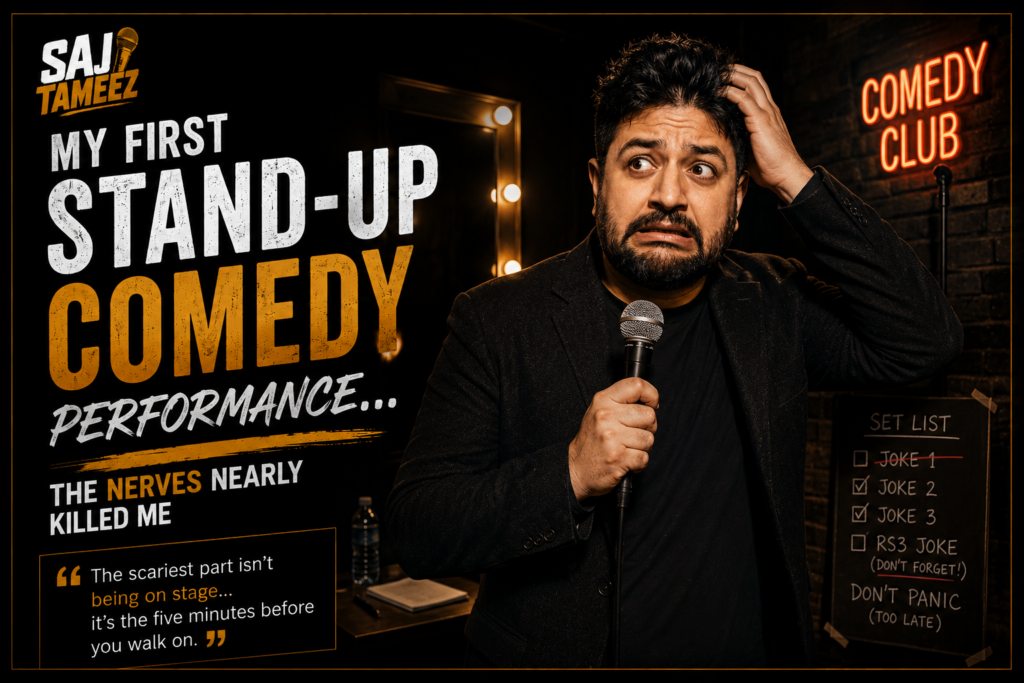
What it really feels like to perform stand-up comedy for the first time
People have this wonderfully romantic idea about stand-up comedy.
They imagine comedians backstage calmly sipping coffee, casually chatting to one another, maybe running through a few jokes in their heads before strolling on stage as though they’re about to pop into Tesco for a loaf of bread.
Allow me to ruin that illusion.
About ten minutes before my first ever stand-up performance, I wasn’t preparing for comedy.
I was preparing my escape.
I’d already mentally cancelled the show at least six times.
Food poisoning was my first choice. It’s believable, difficult to disprove and, most importantly, doesn’t require any acting. Then I thought perhaps a migraine. Chest pains briefly entered the conversation before I realised that pretending to have a heart attack merely because I had to tell a few jokes might be considered a slight overreaction.
Then, in what I can only describe as the bargaining stage of panic, I wondered whether I could simply disappear.
Not dramatically.
Just… quietly.
Walk to the car.
Drive home.
Change my phone number.
Start a new life somewhere nobody had heard of stand-up comedy.
People often say, “Face your fears.”
I was actively looking for directions away from mine.
The ridiculous thing was that, until that point, I’d convinced myself I wasn’t nervous at all.
I’d spent the last year making comedy videos online. Thousands of people had watched them. I’d stood in front of classrooms, delivered presentations, spoken at events and generally developed the quiet confidence that comes from doing something often enough that it no longer frightens you.
Standing on a stage with a microphone couldn’t be that different.
That’s a bit like saying driving a go-kart is basically Formula One.
Technically, yes.
Emotionally, absolutely not.
The evening was being hosted by the brilliant Shreen Mahmood, and somehow I’d found myself sharing the stage with Shazia Mirza, Noreen Khan, Dr Noha and Jay Droch.
I remember looking around thinking something that I suspect every newcomer thinks.
“I’ve made a terrible administrative error.”
Everyone else looked like they belonged there.
They were chatting.
Laughing.
Looking relaxed.
Meanwhile I was conducting what can only be described as an internal risk assessment.
Likelihood of forgetting my material?
High.
Likelihood of falling over?
Moderate.
Likelihood of spontaneously combusting?
Increasing by the minute.
Then the comedian before me walked on.
Now here’s something nobody tells you about stand-up.
You don’t just wait.
You listen.
Every laugh from the audience is like hearing exam results being read out for the person sitting before you.
“Excellent.”
“Outstanding.”
“Distinction.”
And then you realise…
You’re next.
Suddenly I wasn’t even worried about being funny anymore.
I was worried about remembering English.
Have you ever been so nervous you start questioning whether you actually know how conversations work?
“Good evening…”
No.
Too formal.
“Hello…”
Too friendly.
“Alright…”
What if they weren’t?
My brain had abandoned comedy entirely and was now running simulations of social interaction.
Then something remarkable happened.
My heart stopped behaving like an organ and started behaving like a toddler after three cans of Coke.
It wasn’t beating.
It was protesting.
I could actually feel it trying to leave my chest.
By now, my internal monologue had become utterly unhinged.
You know when people say,
“Listen to your inner voice.”
Don’t.
Mine was an idiot.
“You know what?” it said.
“You don’t actually have to go on.”
An interesting point.
“People cancel things all the time.”
Also true.
“You could just… leave.”
Now we’re brainstorming.
My brain suddenly became the world’s most enthusiastic HR department.
“We’ve reviewed the situation, Saj, and after careful consideration we’ve decided this opportunity isn’t aligned with your long-term wellbeing.”
I was actually considering excuses.
Not sensible ones.
Ridiculous ones.
“I’ve just remembered… I’ve left the oven on.”
I was in Birmingham.
I live in Buckinghamshire.
That would’ve been one very committed excuse.
Then I started wondering what constitutes a genuine emergency.
Because if anxiety isn’t technically an emergency…
…it certainly feels like one.
The annoying thing about fear is that it’s incredibly convincing.
It doesn’t tell you you’re frightened.
It tells you you’re sensible.
“This isn’t fear.”
“This is wisdom.”
“Successful people know when to walk away.”
No they don’t.
Terrified people say things like that.
Then somebody said the words every performer eventually hears.
“You’re on next.”
It’s amazing how three perfectly ordinary words can completely ruin your evening.
You’re.
On.
Next.
Not eventually.
Not in a bit.
Not after another drink.
Now.
This is also the point where time starts behaving very strangely.
One minute suddenly lasts about half an hour.
You become aware of things you’ve never noticed before.
Your breathing.
Your heartbeat.
Your feet.
Why have I got feet?
Have they always been there?
Can I still use them?
They suddenly felt like someone else’s.
Walking towards the stage became surprisingly technical.
“Left one.”
“Good.”
“Now the right.”
“Excellent.”
“Don’t fall over.”
It’s incredible that the human body can perform millions of complicated tasks without conscious thought…
…until somebody gives you a microphone.
Then I heard my name.
And something unexpected happened.
Everything went quiet.
Not the room.
My head.
The negotiations stopped.
The excuses disappeared.
The panic packed its bags.
Not because I’d suddenly become brave.
Because I’d run out of time to be afraid.
I walked onto the stage.
The lights hit me.
I smiled.
Picked up the microphone…
…looked at the audience…
…opened my mouth…
…
…and my opening joke had left the country.
Not forgotten.
Gone.
It hadn’t slipped my mind.
It had changed its identity, boarded a flight and was probably halfway to Spain.
Weeks of writing.
Days of rehearsing.
Hours of pacing around the house saying the same lines to myself until my family started looking genuinely concerned.
Gone.
Now, here’s the interesting thing about panic.
It lies.
It tells you that if you forget one joke, everything else will disappear too. Your brain suddenly starts behaving like a dramatic newsreader.
“Breaking News. Local man forgets opening joke. Experts believe he may never remember another sentence for the rest of his life.”
I stood there for what felt like an eternity.
In reality, it was probably half a second.
The audience didn’t know.
Only I knew.
That’s the thing about performing. The audience isn’t watching the version of the show you’ve rehearsed a hundred times in your head. They’re only watching the one that’s happening in front of them. They have absolutely no idea you’ve forgotten something unless you decide to tell them.
Thankfully, somewhere beneath the panic, another joke floated to the surface.
I grabbed it like a man clinging to driftwood.
I said it.
People laughed.
Not politely.
Properly.
The sort of laugh that makes your shoulders drop by about three inches.
I cannot adequately explain what that first genuine laugh does to you.
It’s like your brain suddenly receives a message.
“False alarm.”
“They’re not here to attack you.”
“Carry on.”
Until that moment I’d been trying not to fail.
Now I was simply trying to make people laugh.
They’re two completely different jobs.
Within a couple of minutes, something extraordinary happened.
I forgot I was nervous.
Well… that’s not entirely true.
The nerves were still there, but they’d moved into the background.
Like an annoying relative at a wedding. You know they’re somewhere in the room, but they’re no longer the centre of your attention.
I started listening to the audience.
Responding to them.
Playing with the pauses.
Actually enjoying myself.
And that’s when it hit me.
This wasn’t an exam.
Nobody was sitting there with a clipboard giving me marks out of ten.
Comedy audiences desperately want you to be funny.
Think about it.
Nobody buys a ticket hoping they’ve wasted their money.
They want to laugh.
They’re on your side from the moment you walk on stage.
It’s an oddly comforting thought.
Because in my head I’d somehow imagined two hundred people had gathered together purely to witness my public collapse.
As it turned out…
…they were lovely.
Now don’t get me wrong.
It wasn’t perfect.
I still completely forgot my RS3 joke.
To this day, I’m convinced it was a brilliant joke.
We’ll never know.
It remains one of comedy’s great unsolved mysteries.
Somewhere between joke number seven and the applause at the end, it simply vanished.
The audience never knew it existed.
Only I did.
Which meant I spent the rest of the set mentally mourning a joke that nobody else had lost.
It’s amazing what performers choose to obsess over.
The audience are thinking,
“That was really funny.”
You’re thinking,
“Yes, but what about paragraph three on page four of my notebook from last Tuesday?”
We’re strange people.
The funny thing is, by the end of the set I didn’t want it to finish.
That’s perhaps the biggest surprise of the entire evening.
Twenty minutes earlier I’d been mentally preparing my resignation from comedy.
Now I was wondering whether I could squeeze in another five minutes.
Fear has a funny way of changing shape.
Before you begin, it tells you you’ll never survive.
Halfway through, it quietly disappears without even apologising.
When I walked off stage, the first thing I noticed was that I could breathe again.
It’s amazing how quickly your body forgets it was trying to kill you twenty minutes earlier.
People came over to chat. A few asked how long I’d been doing stand-up. When I told them it was my first ever live performance, there was a moment of genuine disbelief.
“No, seriously… how long?”
“Seriously… that was the first one.”
I’ll admit, that felt rather nice.
Not because I suddenly thought I was the next Michael McIntyre. Far from it. I know I’ve got a huge amount to learn. I forgot material. I rushed a couple of jokes. I know there were pauses I could have used better and moments I’d approach differently next time.
But that’s the point.
There will be a next time.
That sentence simply didn’t exist in my head an hour earlier.
An hour earlier I was trying to work out whether I could fake a medical emergency convincing enough to avoid walking on stage.
Now I was mentally rewriting jokes for the next gig.
It’s extraordinary how quickly your perspective changes once you’ve survived something you were convinced would destroy you.
Driving home, I started replaying the evening in my head.
Not the laughs.
Not the applause.
Not even the forgotten jokes.
I kept thinking about those ten minutes in the car park.
The negotiations.
The excuses.
The endless conversation I’d been having with myself.
Because here’s the strange thing…
None of it was real.
The panic was real.
The racing heart was real.
The dry mouth, the shaking hands, the overwhelming urge to get in the car and disappear… all absolutely real.
But every story my brain was telling me wasn’t.
It had spent the best part of half an hour trying to convince me that if I walked onto that stage, I’d embarrass myself in front of a room full of strangers.
Instead, I walked off stage having had one of the most enjoyable experiences of my life.
Fear has an extraordinary imagination.
It writes entire films in your head.
The trouble is, they’re almost always works of fiction.
I’ve realised that most of the biggest decisions in life aren’t made because we’re fearless.
They’re made because eventually we get tired of listening to fear.
I’ve spoken to so many people over the years who dream of doing something different.
Writing a book.
Starting a business.
Changing careers.
Running a marathon.
Standing on a stage with a microphone.
Almost every conversation ends the same way.
“Maybe one day.”
I’ve said those words myself.
The problem is, one day has an annoying habit of turning into never.
The truth is, you’ll probably never feel completely ready.
You’ll never wake up one morning and think,
“Brilliant. Today seems like the perfect day to willingly put myself in a situation that terrifies me.”
That’s not how courage works.
Courage isn’t the absence of fear.
It’s turning up while your brain is still trying to talk you out of it.
Will I be nervous before my next gig?
Without question.
Will I once again convince myself I’ve made a terrible mistake?
Almost certainly.
Will I still spend ten minutes wondering whether disappearing to another country is a perfectly reasonable career move?
I’d be disappointed if I didn’t.
The difference now is that I’ll recognise that voice.
Not as wisdom.
Not as instinct.
Just fear doing what fear has always done.
Trying to keep me exactly where I am.
And if my first stand-up taught me anything, it’s this.
The stories we tell ourselves before we do something frightening are almost always far scarier than the story we get to tell afterwards.
Oh… and one final thing.
I’ve finally remembered that opening joke.
Only took me about three hours.
I’ve written it down now.
I’m not making that mistake again.
Saj Tameez
Comedian. Author.. Storyteller.